200+ PE Report Card Comments Sorted by Skill, Strand & Performance Level
By Jarrod Robinson · June 18, 2026 · 25 min read
The most comprehensive PE report card comment bank available — 200+ ready-to-use comments organised by movement skill, strand, and performance level. Copy, adapt, and cut your report writing time in half.
PE reports have a particular kind of dread attached to them. Not because you don't know your students — you do. You've watched them grow, struggle, shine, and get back up. You know exactly who each kid is. The problem is translating what you've witnessed into a sentence that makes sense to a parent who wasn't there, fits a character limit, feels authentic, and holds up across 400 students before the deadline hits.
So you start strong. First class — five beautiful, specific comments. Second class — still decent. Third class — you're already borrowing phrases. By the tenth class you're changing names and hoping nobody notices. By the fifteenth you're staring at the screen wondering if PE teachers at other schools have some system you've never been told about.
There are two things that fix this. A workflow — a clear process for structuring comments so you're not starting blank. And words — a bank of 200+ comments you can copy, adapt, and paste. Both are in this post. But before you start copying anything, watch the two-minute video below. It shows a third option that most PE teachers don't know exists.
Before you copy-paste a single comment — watch this first
WHAT YOU JUST SAW
The AI Report Writer does this in 4 seconds.
Type what you observed. Get three polished, curriculum-aligned comment options. Pick one, paste it in. Done.
It's inside ConnectedPE Premium — 13 AI tools built for PE teachers, one price.
Get ConnectedPE Premium — $49 →Or keep scrolling — the 200+ comment bank is below.
The bank is still worth having. Even if you use the AI tool, having a reference of what good looks like — by strand, skill, and performance level — sharpens the observations you feed it. Here's how to get the most out of what's below.
How to use this bank
- Find the strand and skill area that matches your reporting focus.
- Choose the performance level that best describes the student.
- Swap [Name] for the student's name and adjust the pronoun.
- Add one specific, observed detail to make it personal — one concrete thing you noticed transforms a comment from generic to genuine.
Performance levels used throughout:
Excelling — performing above the expected standard; demonstrating advanced skill, knowledge, or attitude.
Achieving — meeting the expected standard; showing consistent, competent performance.
Developing — working towards the expected standard; making progress with support and practice.
Section 1: Fundamental Movement Skills
Locomotor Skills (running, jumping, hopping, skipping, galloping, leaping)
| Excelling | Achieving | Developing |
|---|---|---|
| [Name] demonstrates exceptional locomotor skills, moving with fluency, coordination, and confidence across a wide range of activities. | [Name] demonstrates sound locomotor skills and applies them effectively in a variety of physical activities. | [Name] is developing their locomotor skills and, with continued practice, is showing improvement in movement control and coordination. |
| [Name] performs locomotor patterns — including running, jumping, and skipping — with technical precision and impressive body control. | [Name] performs fundamental locomotor movements with growing accuracy and is developing the confidence to apply them in dynamic settings. | [Name] is building confidence in locomotor movement and benefits from focused practice to improve consistency and fluency. |
| [Name] transitions between locomotor movements with ease, demonstrating high-level spatial awareness and agility across all lessons. | [Name] shows a reliable command of locomotor skills and is beginning to combine and vary movements with greater creativity. | [Name] is working towards performing locomotor skills with greater control and coordination and is making steady progress with support. |
| [Name] consistently applies advanced locomotor patterns across different contexts, adapting their movement seamlessly to changing demands. | [Name] participates enthusiastically in locomotor activities and is refining the timing and flow of their fundamental movement patterns. | [Name] engages positively with locomotor activities and is beginning to show more purposeful movement with encouragement and practice. |
| [Name] serves as an outstanding role model in locomotor activities, demonstrating both technical excellence and joyful engagement with movement. | [Name] demonstrates competent locomotor skills and is growing in their ability to use them expressively and purposefully in PE lessons. | [Name] shows effort and willingness to improve their locomotor skills and responds well to feedback and guided practice. |
Object Control Skills (throwing, catching, kicking, striking, dribbling)
| Excelling | Achieving | Developing |
|---|---|---|
| [Name] demonstrates excellent object control skills, handling a variety of equipment with precision, power, and confidence. | [Name] demonstrates competent object control skills and applies them with increasing consistency across PE activities. | [Name] is developing their object control skills and is making progress when given structured opportunities to practise. |
| [Name] consistently applies advanced throwing, catching, and striking techniques across different activities and game contexts. | [Name] performs fundamental object control tasks well and is growing in their ability to use them effectively in game-based situations. | [Name] is building confidence with object control tasks and is beginning to show improvement in accuracy and control with support. |
| [Name] shows outstanding ability to manipulate objects with precision, adjusting their technique effectively to meet varying task demands. | [Name] shows developing accuracy in object control skills and engages enthusiastically in activities to practise and refine their technique. | [Name] is working towards performing object control skills with greater consistency and benefits from targeted, skill-focused practice. |
| [Name] handles equipment with impressive skill and composure, demonstrating both fine and gross motor control at a high level. | [Name] demonstrates sound foundational skills in throwing, catching, and striking and is becoming more consistent under pressure. | [Name] engages willingly with object control activities and is starting to apply the key technique cues they have been taught. |
| [Name] applies object control skills creatively and confidently across a range of activities, including in unpredictable game situations. | [Name] is developing a reliable foundation in object control and shows growing enjoyment and confidence when practising these skills. | [Name] shows a positive attitude toward object control activities and is making meaningful progress with frequent, supported practice. |
Balance, Stability & Body Coordination
| Excelling | Achieving | Developing |
|---|---|---|
| [Name] demonstrates exceptional balance and body awareness, performing static and dynamic balances with control and composure. | [Name] demonstrates sound balance and body control skills and applies them effectively in a variety of PE contexts. | [Name] is developing their balance and body awareness and is making progress with regular practice and encouragement. |
| [Name] shows outstanding spatial awareness and body control, adapting their positioning confidently in response to movement challenges. | [Name] shows good spatial awareness and is developing the ability to maintain balance in increasingly complex movement situations. | [Name] is building their body control skills and benefits from additional opportunities to practise balance in supported settings. |
| [Name] consistently performs balance and coordination activities with poise and precision, serving as a model of body control for peers. | [Name] performs balance activities with growing confidence and is building a strong foundation in body control and spatial awareness. | [Name] is working towards greater body control and is beginning to hold balances with more focus and steadiness. |
| [Name] applies their exceptional body coordination across diverse activities, transitioning between static and dynamic tasks with fluency. | [Name] engages enthusiastically with balance and coordination activities and is developing the core stability needed for more complex tasks. | [Name] responds positively to coaching cues during balance activities and is demonstrating gradual improvement in control and stability. |
| [Name] demonstrates a sophisticated understanding of how to control their body in space, producing technically refined movement consistently. | [Name] is developing confidence and competence in balance tasks and is able to focus attention on controlling their body for longer periods. | [Name] participates willingly in balance and coordination activities and shows effort and progress when provided with structured support. |
Section 2: Health, Fitness & Physical Activity
Health & Fitness Knowledge
| Excelling | Achieving | Developing |
|---|---|---|
| [Name] demonstrates a sophisticated understanding of health and fitness concepts, consistently applying this knowledge to their participation in PE. | [Name] has a solid understanding of health and fitness concepts and is learning to apply them in practical settings. | [Name] is developing their understanding of health and fitness concepts and is beginning to make connections between activity and wellbeing. |
| [Name] can confidently explain and apply fitness principles — including components such as endurance, strength, and flexibility — in a range of PE contexts. | [Name] demonstrates good awareness of how physical activity benefits health and participates in fitness activities with growing purpose and intent. | [Name] is building their health literacy and benefits from support to understand and connect fitness principles to their own activity choices. |
| [Name] shows exceptional health literacy and engages in thoughtful reflection on how to improve and maintain their own fitness and wellbeing. | [Name] engages well with health and fitness learning and is developing the ability to apply key concepts to their personal activity choices. | [Name] is working towards a clearer understanding of the relationship between physical activity and health and is showing growing interest. |
| [Name] applies their deep understanding of fitness principles to lead warm-ups, demonstrating both subject knowledge and genuine teaching capacity. | [Name] can identify the main components of fitness and is beginning to use this knowledge to monitor and reflect on their own performance. | [Name] is learning the key vocabulary and concepts around health and fitness and is beginning to use them in discussion and reflection. |
| [Name] actively extends their understanding of health and fitness, making connections between in-class learning and their lifestyle choices outside school. | [Name] shows a genuine appreciation for the importance of physical activity for health and applies this understanding with growing confidence. | [Name] is developing an awareness of how lifestyle choices affect health and wellbeing and is making early connections with their learning in PE. |
Want to build richer fitness data into your reporting? Check out The Complete Guide to Fitness Testing in PE.
Effort, Participation & Physical Activity Engagement
| Excelling | Achieving | Developing |
|---|---|---|
| [Name] consistently gives their absolute best in PE and approaches every challenge with energy, enthusiasm, and an outstanding work ethic. | [Name] participates consistently and positively in PE and demonstrates genuine enthusiasm for physical activity. | [Name] is developing their engagement with physical activity and shows improvement when provided with encouraging and supportive environments. |
| [Name] is an exemplary participant who leads by example, always fully engaged and inspiring others with their commitment and effort. | [Name] tries hard in PE lessons and is developing the intrinsic motivation to challenge themselves beyond their comfort zone. | [Name] is building their confidence in PE and is beginning to participate more willingly and consistently in physical activity. |
| [Name] demonstrates outstanding commitment to physical activity, pushing themselves in every lesson and always seeking ways to improve. | [Name] shows solid participation across PE lessons and is growing in confidence as a physically active and engaged learner. | [Name] is working towards more consistent participation in PE and benefits from positive reinforcement and well-structured activities. |
| [Name] arrives at each lesson ready to work hard and brings a contagious enthusiasm that positively influences the class environment. | [Name] is a reliable and willing participant in PE who engages positively with a wide range of activities and movement experiences. | [Name] shows increasing willingness to participate in PE and is beginning to enjoy and engage more purposefully with physical activity. |
| [Name] demonstrates self-driven motivation in PE, consistently seeking to challenge themselves even when tasks are difficult or uncomfortable. | [Name] demonstrates positive participation habits and is learning to see physical activity as something to embrace and genuinely value. | [Name] is working on building consistent effort in PE and shows good progress when activities are well-matched to their current ability. |
Resilience, Personal Challenge & Self-Improvement
| Excelling | Achieving | Developing |
|---|---|---|
| [Name] consistently demonstrates exceptional perseverance and a genuine growth mindset, embracing challenges and never giving up when things get hard. | [Name] demonstrates good resilience in PE and is developing the ability to persist when activities become difficult or uncomfortable. | [Name] is developing their resilience and benefits from encouragement to stay engaged and keep trying when tasks are challenging. |
| [Name] approaches failure and difficulty as opportunities to grow, modelling a wonderfully mature and constructive response to challenge. | [Name] is learning to approach setbacks with a positive and determined mindset, and is growing in their ability to bounce back from difficulty. | [Name] is building their ability to persist through difficulty in physical activity and is beginning to respond more constructively to setbacks. |
| [Name] sets ambitious personal goals in PE and works diligently to achieve them, reflecting meaningfully on their own progress over time. | [Name] shows a willingness to set goals and work towards them in PE, with growing awareness of the effort required to improve. | [Name] is working towards a stronger growth mindset in PE and benefits from clear goal-setting and regular feedback on progress. |
| [Name] demonstrates remarkable resilience and composure, maintaining a positive attitude even in the face of repeated difficulty or perceived failure. | [Name] engages with self-reflection in PE and is learning to use feedback constructively to guide their efforts toward improvement. | [Name] is beginning to see the value of effort and practice in improving their physical abilities and responds well to targeted challenge. |
| [Name] is a powerful example of what a growth mindset looks like in action — committed, reflective, and always pushing themselves forward. | [Name] demonstrates a developing sense of personal challenge in PE and is gaining confidence in setting and working towards meaningful goals. | [Name] shows positive signs of resilience in PE and is gradually building the mindset needed to embrace challenge and learn from difficulty. |
Halfway through and realising this is still a lot of work?
The AI Report Writer turns a few quick observations into a polished, curriculum-aligned comment in seconds. It lives inside ConnectedPE Premium alongside 12 other AI tools built for PE teachers.
Get ConnectedPE Premium — $49 →Section 3: Game Play, Sport & Tactical Thinking
Tactical Awareness & Decision Making
| Excelling | Achieving | Developing |
|---|---|---|
| [Name] demonstrates exceptional tactical intelligence, reading the game with clarity and making effective, well-timed decisions in complex situations. | [Name] demonstrates solid tactical awareness and is developing the ability to make effective decisions in game-based situations. | [Name] is developing their tactical awareness and is beginning to make more deliberate and thoughtful decisions during game play. |
| [Name] anticipates play with impressive accuracy, positioning themselves strategically and creating opportunities with consistently smart decision-making. | [Name] shows good understanding of game structures and is applying tactical knowledge with increasing confidence and effectiveness. | [Name] is building their game sense and benefits from guided questioning and small-sided games to develop tactical understanding. |
| [Name] applies advanced attacking and defensive principles across a range of games, demonstrating both creativity and technically sound judgement. | [Name] engages effectively in game play and is growing in their ability to read situations and respond with appropriate tactical choices. | [Name] is working towards a clearer understanding of game tactics and is beginning to engage with the strategic elements of sport. |
| [Name] demonstrates a sophisticated ability to switch between offensive and defensive roles, consistently making decisions that benefit the team. | [Name] shows growing awareness of space, timing, and movement in game situations and is applying these concepts with developing confidence. | [Name] is showing early signs of tactical thinking and responds well when prompted to think about positioning and decision-making. |
| [Name] leads tactical discussions with confidence, helping teammates understand game structures and demonstrating outstanding game intelligence. | [Name] participates with genuine tactical intent in game activities and is strengthening their ability to execute decisions under pressure. | [Name] engages with tactical tasks in small-sided games and is beginning to make more intentional choices about when and how to act. |
Teamwork & Communication
| Excelling | Achieving | Developing |
|---|---|---|
| [Name] is an outstanding team player who communicates effectively, supports teammates consistently, and contributes strongly to group success. | [Name] works well with others in team activities and is developing the communication skills needed to be a more effective teammate. | [Name] is developing their teamwork skills and is learning to work constructively and cooperatively with others in group activities. |
| [Name] demonstrates exceptional collaborative skills, leading with encouragement, empathy, and decisive communication that lifts the whole team. | [Name] demonstrates positive teamwork in PE and is learning to contribute constructively and support peers in shared activities. | [Name] is building their ability to communicate and collaborate in team settings and benefits from structured cooperative tasks. |
| [Name] shows exemplary ability to share roles, listen to others, and bring out the best in teammates in both competitive and cooperative contexts. | [Name] engages cooperatively in team activities and is growing in their confidence to communicate and take on leadership in group settings. | [Name] is working towards more effective teamwork and is beginning to show greater willingness to support, include, and encourage peers. |
| [Name] models the very best qualities of a team player — reliability, encouragement, and the ability to put the group's needs ahead of their own. | [Name] is a willing and positive team member who contributes fairly and is developing the interpersonal skills that underpin great teamwork. | [Name] is developing confidence in team situations and benefits from structured group roles that support their communication and engagement. |
| [Name] fosters a positive team culture through their actions and communication, regularly lifting teammates and helping the group perform at its best. | [Name] communicates with growing effectiveness in team situations and is learning to share ideas, listen, and respond to the needs of the group. | [Name] is learning to be a more effective teammate and is beginning to communicate more clearly and contribute more consistently. |
Fair Play & Sportsmanship
| Excelling | Achieving | Developing |
|---|---|---|
| [Name] consistently demonstrates outstanding sportsmanship, showing genuine respect for opponents, teammates, and officials in all activities. | [Name] demonstrates positive sportsmanship in PE and is developing the maturity to handle competitive situations with respect and composure. | [Name] is developing their sportsmanship skills and is learning to respond to wins and losses with greater composure and respect. |
| [Name] is a model of fair play, handling both success and disappointment with grace, maturity, and unwavering respect for all involved. | [Name] generally shows respect and fair play in physical activities and is learning to manage emotions constructively in competitive settings. | [Name] is building their understanding of fair play and benefits from guidance to show consistent respect in competitive activities. |
| [Name] actively promotes a fair, inclusive, and respectful environment through their words and actions in every lesson. | [Name] engages with fair play principles in PE and is growing in their ability to demonstrate consistent respect for others throughout lessons. | [Name] is working towards demonstrating fair play across all PE activities and shows improvement when expectations are clearly reinforced. |
| [Name] approaches competition with exactly the right mindset — eager to win, but always within the spirit of the game and respectful of others. | [Name] shows a developing ability to handle the pressures of competition with increasing maturity and emotional regulation. | [Name] is learning to separate the competitive outcome from their treatment of others and is beginning to show more consistent fair play. |
| [Name] leads the class culture of respect and sportsmanship, consistently demonstrating what it looks like to compete with integrity and joy. | [Name] is a respectful competitor who acknowledges the effort of others and is growing in their ability to remain composed under pressure. | [Name] is developing the emotional maturity to respond to competitive situations respectfully and is making steady progress with support. |
Section 4: Personal & Social Development
Self-Management & Responsibility
| Excelling | Achieving | Developing |
|---|---|---|
| [Name] demonstrates exceptional self-management in PE — transitioning efficiently, following instructions independently, and using time productively. | [Name] manages themselves well in PE lessons and is developing the ability to work independently and take ownership of their learning. | [Name] is developing their self-management skills in PE and benefits from reminders and clear routines to stay on task and engaged. |
| [Name] shows outstanding ability to manage their own behaviour and learning, taking initiative and maintaining focus across all lesson phases. | [Name] shows good self-management in physical activity settings and is learning to set goals and reflect on their own effort and progress. | [Name] is building their independence in PE and is beginning to take greater ownership of their behaviour and participation choices. |
| [Name] consistently demonstrates self-discipline and initiative, organising themselves effectively and contributing to a productive learning environment. | [Name] demonstrates positive self-management habits in PE and is growing in their ability to take initiative and work without close supervision. | [Name] is working towards stronger self-management in PE and shows improvement when expectations, structures, and routines are clearly in place. |
| [Name] takes full responsibility for their learning in PE, self-assessing honestly, using feedback constructively, and acting on it without prompting. | [Name] is developing a reliable sense of personal responsibility in PE and is learning to manage transitions and tasks with growing independence. | [Name] is learning to take responsibility for their engagement in PE and responds well to structured reminders and clear lesson expectations. |
| [Name] models outstanding classroom citizenship in PE — always on task, respectful of shared spaces, and a stabilising, positive presence for others. | [Name] manages themselves appropriately across most lesson phases and is growing in confidence to lead their own learning and goal-setting. | [Name] is building the habits of self-management gradually and shows positive progress when given consistent structure and supportive feedback. |
Leadership & Initiative
| Excelling | Achieving | Developing |
|---|---|---|
| [Name] demonstrates outstanding leadership in PE, taking initiative, making sound decisions, and inspiring confidence in those around them. | [Name] shows positive leadership qualities in PE and is developing the confidence to take on roles that require initiative and responsibility. | [Name] is developing their leadership capacity and is beginning to show moments of initiative and willingness to step up in group settings. |
| [Name] leads with empathy and authority, balancing their own performance with a genuine commitment to helping others succeed. | [Name] takes on leadership opportunities with growing confidence and is learning to guide, encourage, and support peers constructively. | [Name] is building their confidence to lead in PE and benefits from supported opportunities to practise taking on responsible roles. |
| [Name] consistently volunteers for leadership roles, approaches them with maturity, and makes a meaningful positive impact on their peers. | [Name] demonstrates developing leadership skills in PE and is beginning to take initiative in organising, directing, and supporting group activities. | [Name] is working towards taking on a greater leadership role in PE and responds positively when given structured opportunities to lead. |
| [Name] anticipates what the class or group needs and takes independent action — adjusting equipment, encouraging peers, or solving problems on the spot. | [Name] is showing increasing willingness to lead and is building the communication and confidence skills that underpin effective leadership. | [Name] shows early signs of leadership potential in PE and benefits from mentoring and practice to develop the confidence and skills required. |
| [Name] is the kind of student who lifts the learning environment simply by being present — proactive, generous with support, and naturally inspiring. | [Name] engages positively with leadership challenges and is developing a clearer sense of what it means to lead by example in physical activity. | [Name] is beginning to identify moments where they can step up and lead in PE and is making progress with encouragement and guidance. |
Inclusivity & Respect for Others
| Excelling | Achieving | Developing |
|---|---|---|
| [Name] is an outstanding example of inclusive behaviour, actively welcoming and supporting students of all abilities, backgrounds, and experiences. | [Name] demonstrates respectful and inclusive behaviour in PE and is learning to actively support the participation of all classmates. | [Name] is developing their understanding of inclusivity in PE and is learning to show greater consideration for the needs of all students. |
| [Name] consistently shows empathy and genuine care for the wellbeing of others, creating a safe and welcoming environment in every PE lesson. | [Name] shows genuine care for the wellbeing of others in PE and is growing in their ability to create inclusive experiences for peers. | [Name] is building their empathy and respect for diverse abilities and backgrounds in physical activity settings. |
| [Name] actively ensures that all students feel valued and capable of participating — adapting games, offering encouragement, and including everyone. | [Name] engages positively with students of all abilities in PE and is developing a strong understanding of inclusive values in sport and activity. | [Name] is working towards more consistently inclusive behaviour and benefits from guidance, modelling, and explicit inclusive practice. |
| [Name] actively challenges exclusion and promotes a culture of belonging, demonstrating moral courage and wonderful human qualities in PE. | [Name] is a kind and respectful member of the class who supports peers genuinely and is growing in their awareness of equitable participation. | [Name] is learning to appreciate the diverse strengths and experiences that all students bring to PE and is making encouraging progress. |
| [Name] treats every student with dignity and respect, making their presence a powerful force for belonging, equity, and joy in physical activity. | [Name] consistently shows respect for others in PE and is developing the empathy and awareness to make inclusion an active part of their practice. | [Name] is developing their capacity for empathy and inclusivity in PE and responds positively when inclusive values are explicitly discussed and modelled. |
For specific activity ideas to support inclusive classes, see 15 Inclusive PE Activities for Every Student.
Section 5: Physical Literacy & Lifelong Movement
More on what physical literacy means and why it matters: What Is Physical Literacy and Why Does It Matter in PE?
Physical Literacy & Active Lifestyle
| Excelling | Achieving | Developing |
|---|---|---|
| [Name] demonstrates a strong, authentic connection to physical activity and consistently engages with movement as a source of joy, meaning, and identity. | [Name] demonstrates a positive attitude towards physical activity and is developing a healthy, lasting relationship with movement and wellbeing. | [Name] is developing a more positive relationship with physical activity and benefits from enjoyable, affirming PE experiences that build confidence. |
| [Name] shows outstanding physical literacy — they move skilfully, make intentional choices about activity, and understand and value the role of movement in their life. | [Name] engages enthusiastically with PE and is learning to make meaningful connections between physical activity and their own health and happiness. | [Name] is building their confidence and sense of enjoyment in PE and is beginning to see movement as something valuable and accessible to them. |
| [Name] applies their physical skills with confidence and adaptability, embracing a diverse range of movement contexts and challenges inside and outside school. | [Name] shows a growing appreciation for the role of PE in supporting wellbeing and participates with increasing confidence, skill, and enthusiasm. | [Name] is working towards a more positive and consistent engagement with physical activity and responds well to encouraging, student-centred PE experiences. |
| [Name] actively seeks out physical activity beyond school and reflects thoughtfully on how movement contributes to their overall health and happiness. | [Name] is building physical literacy across a range of movement domains and is developing the understanding and motivation needed for a lifelong active life. | [Name] is beginning to see the value and enjoyment in physical activity and is making early but meaningful steps toward a more active lifestyle. |
| [Name] embodies physical literacy in the truest sense — skilled, motivated, knowledgeable, and genuinely committed to an active and healthy life. | [Name] shows a developing sense of themselves as a physically active person and is growing in confidence, skill, and appreciation for movement. | [Name] is developing their physical literacy gradually and, with the right support and experiences, is beginning to engage more positively with movement. |
Dance, Creative & Rhythmic Movement
| Excelling | Achieving | Developing |
|---|---|---|
| [Name] excels in dance and creative movement, demonstrating outstanding rhythm, expression, and spatial awareness with consistent confidence and flair. | [Name] engages positively with dance and creative movement activities and is developing confidence in expressing themselves through movement. | [Name] is developing confidence in dance and creative movement and is beginning to explore expression and rhythm with growing comfort. |
| [Name] performs with exceptional expressiveness and musicality, bringing creativity and technical skill to all dance and rhythmic movement tasks. | [Name] demonstrates sound rhythm and coordination in dance activities and is growing in their willingness to express themselves through movement. | [Name] is building their movement vocabulary in creative contexts and benefits from structured, low-risk opportunities to explore dance and expression. |
| [Name] approaches creative movement with bravery and imagination, producing work that is both technically accomplished and authentically expressive. | [Name] participates with growing enthusiasm in creative and rhythmic movement activities and is refining their timing, spatial awareness, and expression. | [Name] is working towards a greater sense of comfort and expression in dance tasks and is showing encouraging progress with peer and teacher support. |
| [Name] collaborates brilliantly in group movement compositions, contributing creative ideas and supporting others to bring the sequence to life. | [Name] works well with others in group dance activities and is learning to combine movement ideas collaboratively with growing confidence. | [Name] is beginning to contribute their own movement ideas in creative tasks and is growing in willingness to perform in front of others. |
| [Name] demonstrates a natural joy and freedom in creative movement settings, consistently producing work that reflects both skill and genuine self-expression. | [Name] is developing their capacity for creative movement and is showing an increasing ability to interpret ideas, moods, and rhythms through movement. | [Name] engages more willingly with dance and rhythmic movement as their confidence grows and is showing developing effort and expressiveness. |
Tip: Making these comments genuinely personal. The single most effective thing you can do with any of these comments is add one specific, observed detail — a moment you actually saw. "...particularly evident during the invasion game unit" or "...as shown in their improvement between the Term 1 and Term 3 fitness tests" takes a comment from generic to credible in five words. You don't need to rewrite the whole thing; one anchor point is enough.
The Faster Way: Let AI Write the Comments For You
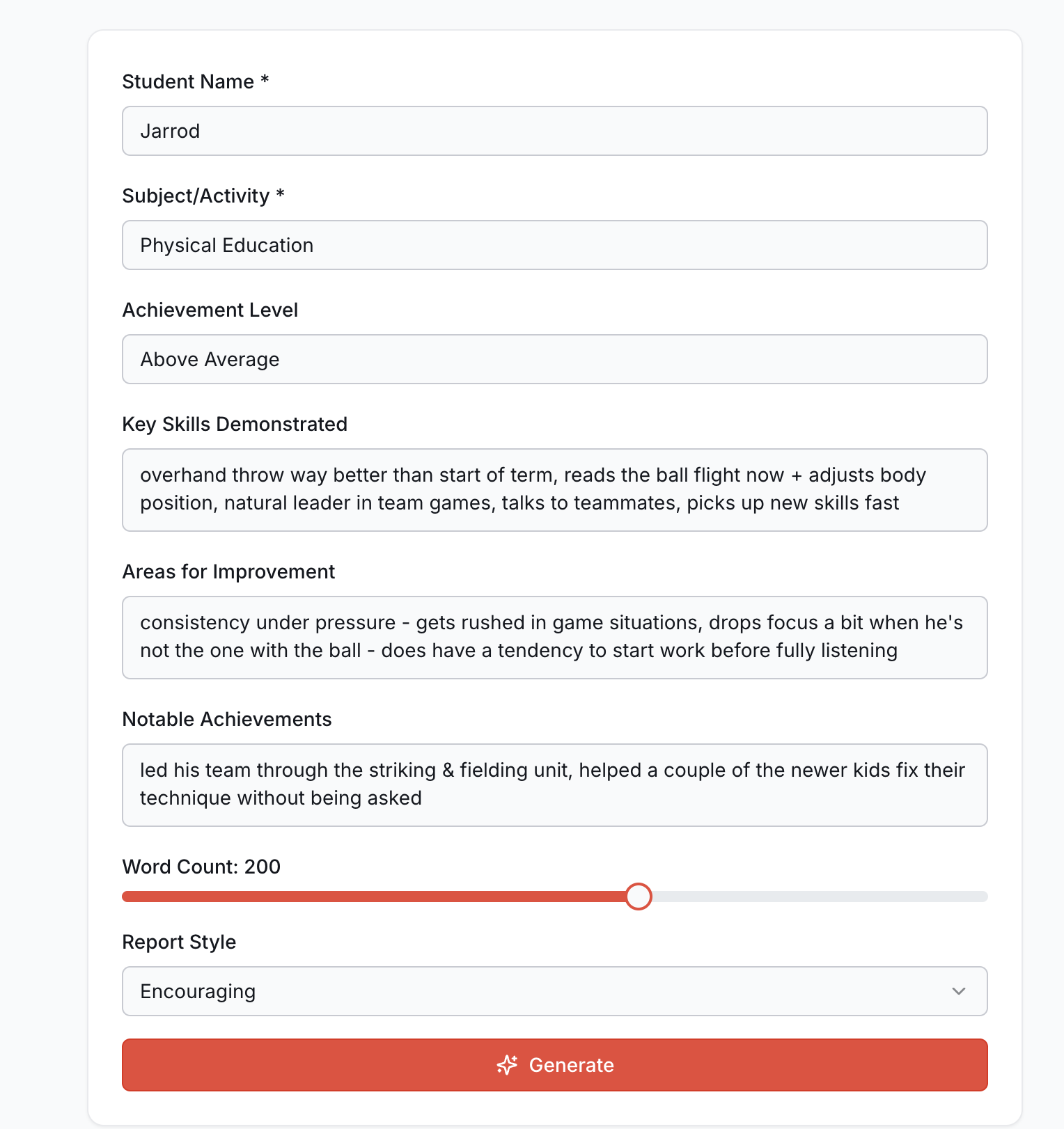
If you made it this far through the bank, you've seen what 200+ comments looks like. Now imagine not needing any of them. The AI Report Writer works like this: you type a few short observations — "great attitude, improved loads in Term 3, still working on object control" — and it generates three polished, curriculum-aligned comment options in about four seconds. You pick one, tweak if you want, paste it in. Then move on to the next student.
It's inside ConnectedPE Premium — 13 AI tools built specifically for PE teachers, one subscription.
- AI Report Writer — observations in, polished comments out
- AI Lesson Planner, Rubric Generator, Game Designer, and 10 more
- Unlimited AI credits — never run out mid-report season
- Full video course library and all premium resource downloads
- Every future tool included automatically
If you've been writing PE comments manually for years — this is the upgrade.
Join thousands of PE teachers using ConnectedPE Premium.
Get ConnectedPE Premium — $49 →You might also like
- How to Write PE Report Card Comments in Minutes — the strategic guide to structuring your whole report workflow. Read this first.
- ConnectedPE Premium — AI Report Writer + 12 other tools. Get it for $49.
- PE Assessment Rubrics: Free Templates — build the assessment data that makes reporting easier.
- The Complete Guide to Fitness Testing in PE — quantifiable data to anchor your fitness comments.
Tags: Physical Education, Assessment, Teaching Tips, Report Writing, Teaching Strategies, Professional Development, Curriculum