How to Run a Bjerring Tournament in PE (High Engagement, Every Sport)
By Jarrod Robinson · August 8, 2026 · 8 min read
The Bjerring tournament is one of the highest-engagement formats you can run in PE: short 2.5-minute games, rotating partners, individual scoring and zero eliminations. Here's exactly how it works, how to run it with any class size, and the free template to take it straight into your next lesson.
If you've ever run a knockout tournament in PE, you know exactly how it goes. Half your class is eliminated in the first ten minutes, your strongest students dominate every game, and you spend the rest of the lesson trying to keep the "out" kids occupied while four students play the final.
There's a better way, and it's been hiding in plain sight for decades. It's called a Bjerring tournament, and once you've run one, it's genuinely hard to go back to anything else. Every student plays every round, games are short and sharp, teams reshuffle constantly so no one gets stuck on a stacked (or struggling) side, and every single point matters right up until the final whistle.
In this post I'm going to break down exactly what a Bjerring tournament is, why the format produces such high engagement in a PE setting, how to run one step by step, and how to pair it with the free Station Timer widget so the whole thing basically runs itself. There's also a free ready-to-print Bjerring Tournament Template with all the rotation formulas and a score sheet, so you can take this straight into your next lesson.
What Is a Bjerring Tournament?
A Bjerring tournament is a round-robin format with a twist: students compete as individuals, but play in pairs or triples that rotate every round. Over the course of the tournament, you play with different partners and against different opponents each round, but your wins and points belong to you alone.
That one design decision changes everything. In a normal teams tournament, a weaker player can hide (or be blamed). In a Bjerring tournament, there are no permanent teams to carry you or drag you down — the rotation evens everything out, and the leaderboard reflects how you went across the whole session.
The format comes from racquet sports, where it's long been used for social doubles competitions, but it transfers beautifully to almost any small-sided game: badminton, volleyball, table tennis, pickleball, tchoukball, 2v2 basketball, spikeball, handball — anything you can play in pairs or triples on a small court or zone.
Why the Format Works So Well in PE
1. Short games keep intensity sky-high
Bjerring rounds are short — I'd recommend somewhere between 2.5 and 4 minutes per round for most classes (the template suggests 3–5 minutes as a general range). That's short enough that students play flat-out for the entire round. There's no pacing yourself, no dead time, no "we're 15 points down so why bother" — the round ends before anyone has a chance to switch off, and then the teams reshuffle and everyone starts fresh.
2. Nobody is ever eliminated
Every student plays every round, from the first whistle to the last. Compare that to a knockout bracket, where half your class becomes spectators after one game. In a 40-minute lesson with 2.5-minute rounds, every student can get 8–12 competitive games. That's a massive amount of activity time and touches on the ball (or shuttle, or whatever you're playing with).
3. Rotating partners kills team stacking
Because partnerships change every round, there's no "stacked team" problem and no social politics about who's with who. Your strongest player partners with your least experienced player at some point, and something really nice happens: stronger students start coaching, communicating, and covering for teammates, because their own score depends on making every partnership work.
4. Individual accountability without individual pressure
Students earn their own wins and points, so everyone is invested — but they're never standing alone on a court being watched by the whole class. They always have a partner. It's individual competition wrapped in the social safety of a team game, which is exactly the right amount of pressure for most students.
5. Every point matters, not just every win
The scoring system (more on this below) counts wins first, then point differential as the tiebreaker. So even if a pairing is losing a round, every point they claw back could decide their final placing. Students figure this out remarkably quickly, and it completely removes the "give up when behind" behaviour you see in win/loss-only formats.
6. One format, every sport
Once your class knows how a Bjerring tournament works, you can reuse the exact same structure across your entire year: badminton in term 1, volleyball in term 2, table tennis on a rainy day. The rules of the sport change; the tournament engine stays the same. That familiarity means setup time shrinks to almost nothing after the first run.
How the Scoring Works
Scoring is simple enough for students to manage themselves:
- At the end of each round, every player records a win or a loss for that round.
- Every player also records the point differential — the margin their pairing won or lost by — as a running cumulative total.
- The winner is the player with the most wins. If two or more players are tied on wins, the highest cumulative point differential decides it.
So if you win one game by 5 points and lose the next by 2, you're sitting on 1 win and +3 points. It takes students about one round to understand, and the running differential is what keeps the back end of every game meaningful.
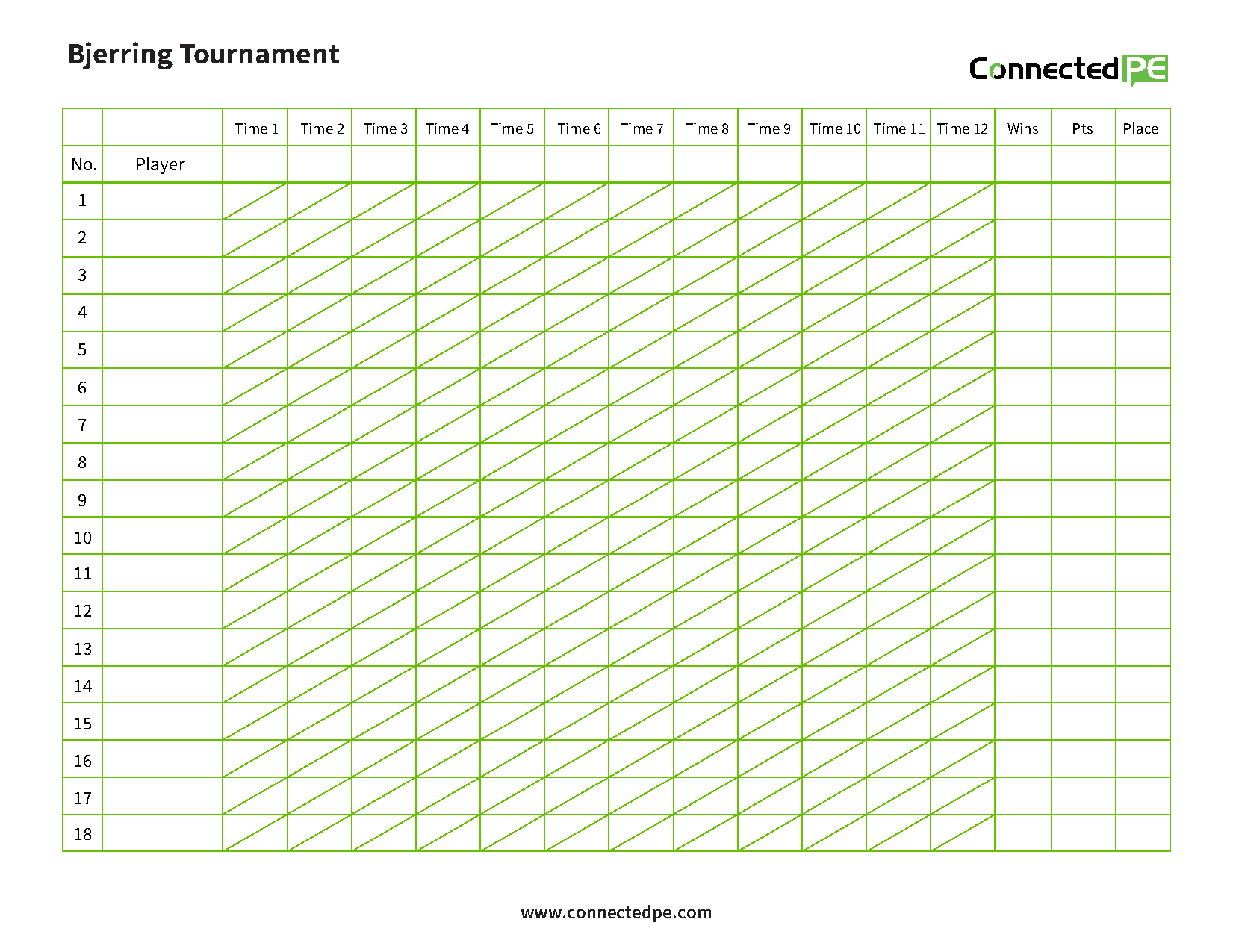
Hand the score sheet to the students. Each player (or each court) records their own results between rounds — it takes 20 seconds, builds honesty and ownership, and means you're free to coach instead of administrate. The free template includes a recording sheet with columns for every round, wins, points, and final placing for up to 18 players.
The Rotation Formulas (This Is the Magic Bit)
The genius of the Bjerring format is a set of pre-worked rotation formulas that guarantee a fair mix of partners and opponents for a given group size. You don't need to work anything out on the fly — you just read the pairings off the sheet each round.
Here's the doubles rotation for a group of 4 players (each number is a player):
| Round | Pairings |
|---|---|
| Time 1 | 1, 2 vs. 3, 4 |
| Time 2 | 1, 3 vs. 2, 4 |
| Time 3 | 1, 4 vs. 2, 3 |
Three rounds, and every player has partnered with every other player exactly once, and played against everyone twice. Completely balanced. No arguments.
The full template includes formulas for:
- Doubles: 4 players (3 rounds), 5 players with a rotating bye (5 rounds), and 8 players across two courts (7 rounds)
- Triples: 7 players (7 rounds) and 9 players (12 rounds)
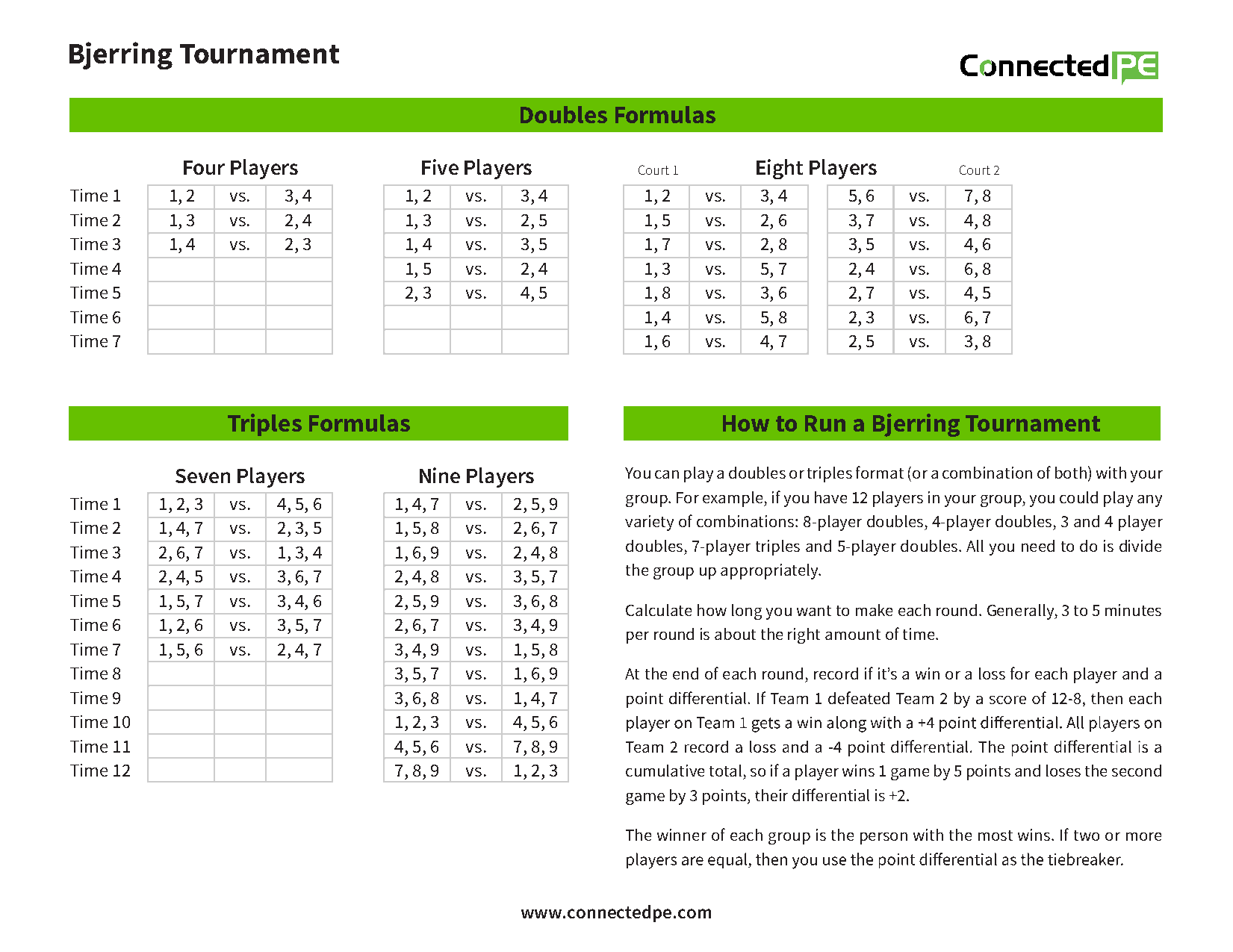
With a group of 5, one player sits out each round (a natural built-in rest — or give them a role like scoring or officiating). The 8-player version runs on two courts simultaneously, which is where the format really starts to scale.
What about a full class of 24 or 30?
This is the question I always get, and the answer is what makes Bjerring so practical: you run multiple groups at once. The formulas are modular, so you just divide your class into groups and give each group a court or zone. For example:
- 12 students: 8-player doubles + 4-player doubles, or 7-player triples + 5-player doubles
- 20 students: two 8-player doubles groups + one 4-player group
- 27 students: three 9-player triples groups
- 30 students: three 8-player groups + one 5-player group + officiating/coaching roles, or any mix that suits your space
Every group runs on the same round clock, so the whole class moves in sync. You can even group by ability (a "championship court" and development courts) or deliberately mix — the format handles both.
Running a Bjerring Tournament: Step by Step
- Choose your sport and set up courts. Small-sided is best — badminton courts, half volleyball courts, table tennis tables, or cone-marked zones for invasion games.
- Print the template and divide the class into groups of 4, 5, 7, 8 or 9 players. Give every player a number within their group.
- Set your round length. 2.5–4 minutes works brilliantly for most sports and year levels. Shorter rounds = more rotations, more intensity, more partners.
- Play Round 1. Players find their pairing from the formula sheet and go. First serve/possession can be decided with rock-paper-scissors.
- At the buzzer, record results. Win/loss plus point differential on the score sheet — 20 seconds, done by the students.
- Read out the next round's pairings and go again. Repeat until you're through the formula (or out of time — the format degrades gracefully if you don't finish every round).
- Crown your winners. Most wins takes it; cumulative points settles any ties.
First time through, budget five minutes to explain the rotation idea. After that, students read the formulas themselves and the tournament effectively self-organises.
Pair It with the Station Timer Widget
The one thing a Bjerring tournament needs from you during the lesson is timekeeping — consistent rounds, a clear signal to stop, a short recording window, then the next round. That's exactly what the free Station Timer widget was built for.
Here's the setup I'd use:
- Activity time: 2 minutes 30 seconds — this is the playing round
- Transition time: 30–45 seconds — students record scores and find their next pairing
- Number of rotations: however many rounds your group size needs (3 for 4-player doubles, 7 for 8-player doubles, and so on)
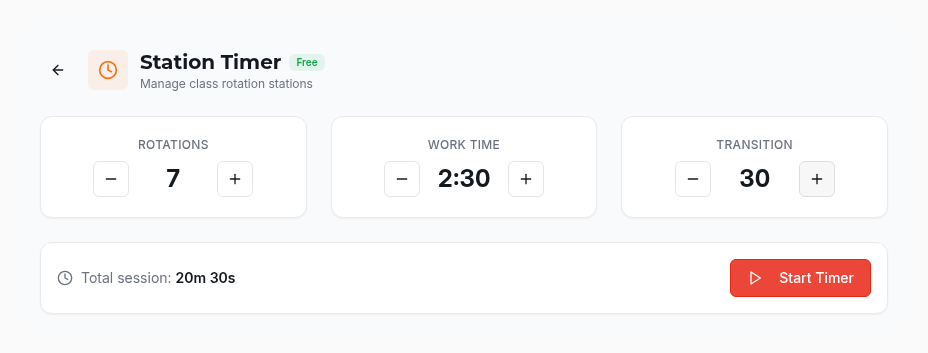
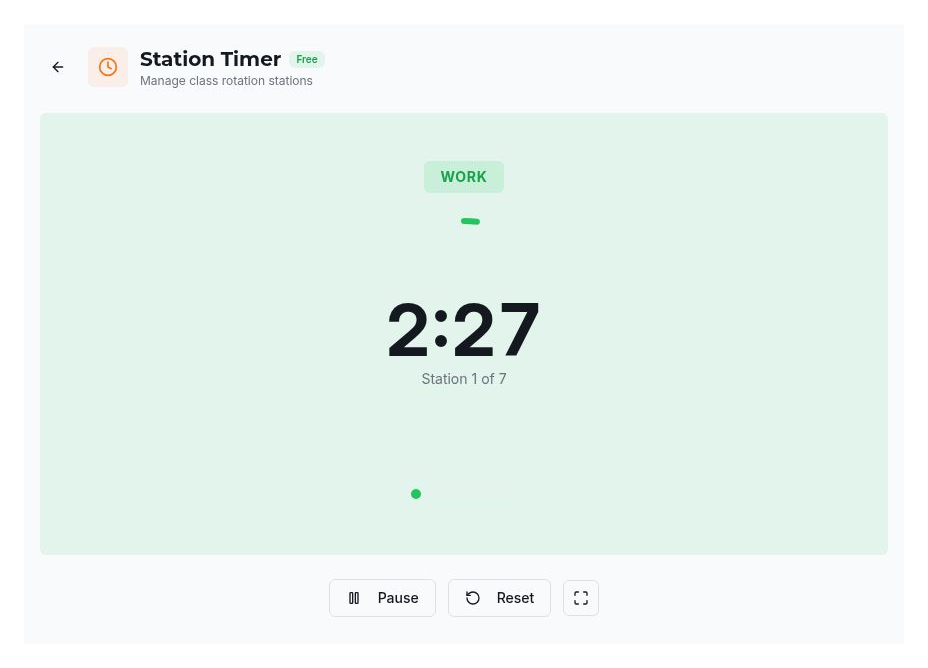
Throw it up on a projector or TV and the widget becomes the referee: a big countdown everyone can see, an audible signal at the end of each round, and an automatic transition window for scoring. You never touch a stopwatch, and students stop asking "how long left?" because the answer is on the wall. It runs free in any browser — no account, no app, no setup beyond typing in two numbers.
If you want to go one step further, the Round Robin widget can generate schedules for standard fixed-team tournaments too — handy for the weeks you want traditional teams instead.
Grab the Free Bjerring Tournament Template
Everything in this post is packaged into a two-page, print-and-go resource in the ConnectedPE library: the Bjerring Tournament Template.
It includes:
- All five rotation formulas — doubles for 4, 5 and 8 players, triples for 7 and 9 players
- Clear instructions for running the format and combining group sizes for any class number
- The scoring system explained (wins + cumulative point differential)
- A ready-to-print recording sheet for up to 18 players across 12 rounds
The template is free for ConnectedPE members — and a free account takes about 30 seconds to create. Download it, laminate a class set, and you've got a tournament engine you can reuse with every sport you teach for the rest of the year.
Give it a run in your next lesson and let me know how it goes — I genuinely think this is one of the highest engagement-per-minute formats you can run in a PE classroom.
Tags: Tournament, Game Format, Games & Activities, Class Management