Yoga in PE: The Complete Guide to Creating Calm, Focused, and Happy Classrooms
By Jarrod Robinson · March 1, 2026 · 6 min read
A comprehensive guide to bringing yoga into your PE program — practical poses, breathing techniques, projection resources, unit planning ideas, and free downloadable student worksheets.
Why Yoga Belongs in Your PE Program
Consider these numbers: 88% of students report feeling stressed about study. Almost half of all young people say stress is impacting their mental health, wellbeing, and physical health. And 45% say they have a hard time concentrating on schoolwork.
As PE teachers, we're uniquely positioned to help. We already have the space, the time, and the trust of our students. Yoga gives us the tools.
Yoga is so much more than exercise. Self-acceptance is one of the biggest philosophies that comes through yoga practice. And if students learn this early, it changes how they show up — in the classroom, on the field, and in life.
Emma & Carla, The Merrymaker Sisters
The evidence backs them up. Research consistently links school-based yoga to reduced anxiety, improved emotional regulation, better focus, and stronger body awareness. And the best part? You don't need to be a yoga instructor to make it work.
The Benefits: Physical, Mental, and Social
Physical Benefits
Yoga develops flexibility, strength, balance, and coordination — core components of any PE curriculum. It's also lower impact, making it accessible to students who may not thrive in traditional sport-heavy lessons.
"It's no beep test," the Merrymaker Sisters note. "But if you've ever held warrior two for more than 60 seconds, you know it's a workout." For PE teachers working with mixed-ability groups, this matters. Yoga gives every student the opportunity to challenge themselves at their own level.
Mental Benefits
This is where yoga really earns its place in PE. Students who practice yoga — even briefly — report reduced stress and anxiety, improved concentration, and better emotional regulation.
I was one of those emotional students. I cried all the time. Yoga has helped me so much as an adult. And I just wonder what it would have been like to have a practice like this as a kid.
Carla, The Merrymaker Sisters
Even three minutes of breath work can shift a student's state. That's not speculation — it's something PE teachers can test on Monday morning.
Social Benefits
Although yoga seems like an individual practice, it fosters community, empathy, and respect. The word "yoga" itself means "to unite" — connecting body with breath, mind with heart, and individuals with each other. For PE teachers focused on social-emotional learning (SEL) outcomes, yoga is one of the most natural integration points available.
The Four Key Principles: Breath, Movement, Mindfulness, Connection
You don't need to run a full yoga session to bring yoga into your PE program. The Merrymaker Sisters break it down into four principles that can be woven into any lesson:
1. Breath
Start here. The simplest entry point is teaching students to notice their breathing.
Try this on Monday: Before your first activity, have students sit comfortably, close their eyes, and take nine slow breaths — inhaling for a count of four, holding, exhaling for a count of four, holding. Three minutes. That's it.
Alternate nostril breathing is another technique that's surprisingly engaging for students: block the right nostril with your thumb, inhale through the left for four counts, switch and exhale through the right. It sounds simple, but the focus required means students genuinely switch off from distractions.
2. Movement
You don't need an hour-long yoga session. Even five minutes of sun salutations at the start of a warm-up brings awareness to alignment, strength, and flexibility. Key poses to start with:
- Mountain Pose (Tadasana) — Standing tall, grounding through the feet. Perfect for teaching posture and body awareness.
- Warrior II (Virabhadrasana II) — Builds leg strength and focus. Hold for 30–60 seconds per side.
- Tree Pose (Vrksasana) — Balance and concentration. Students love the challenge of holding it longer.
- Downward Dog (Adho Mukha Svanasana) — Full-body stretch that also builds upper body strength.
- Child's Pose (Balasana) — A resting pose that teaches students it's OK to pause.
3. Mindfulness
Mindfulness doesn't mean sitting still for 15 minutes (your students probably won't do that, and that's fine). It means bringing awareness to the present moment during any activity.
Try cueing mindfulness during existing activities: "Notice where your weight is as you land." "Feel your breathing change as you speed up." "Can you hear the rhythm of the ball?"
4. Connection
Partner poses, group sequences, and even simple check-ins ("How does your body feel right now?") build connection — to self and to others.
Projecting Yoga on the Big Screen: The Best Resources
One of the most practical ways to bring yoga into PE is to project follow-along videos on your gym screen or interactive whiteboard. Here are the best resources, broken down by age group:
For Primary / Elementary (Ages 5–10)
Cosmic Kids Yoga — The gold standard for younger students. Jaime takes kids on yoga adventures themed around popular movies and characters (Frozen, Moana, Star Wars). Over 800 videos on YouTube, plus an ad-free app. Sessions range from 10–30 minutes.
GoNoodle — Used in 4 out of 5 US elementary schools. Their partnership with Little Flower Yoga produced a series of classroom-specific yoga videos. Free to use. Great for 5–10 minute yoga brain breaks.
Sing Song Yoga — A customisable app that uses song lyrics to teach yoga poses. Particularly effective for ages 2–11. Available on iOS.
For Middle / High School (Ages 11–18)
Yoga With Adriene — Schools Portal — Adriene's free "Yoga P.E." series is specifically designed for school settings, with short mindful movement breaks. She also has a dedicated teachers portal with curated playlists.
The Merrymaker Sisters (MerryBody) — Their sessions are upbeat, accessible, and geared toward the wellbeing angle that resonates with teens. Their ConnectedPE session is available on the platform for members.
Tips for Projecting
- Test your audio first. Yoga relies heavily on verbal cues. Make sure your speaker setup carries across the gym.
- Mirror the video. If students face the screen, the instructor's left becomes their right. Simply cue students to follow as they see it.
- Position matters. Project low and large so students on mats can see without craning their necks.
- Add your own cues. Pause the video to add alignment reminders or modifications. You're still the teacher — the video is just a tool.
How to Structure a Yoga Unit in PE
Here's a practical framework for a 4–6 week yoga unit:
Weeks 1–2: Foundations
- Introduce the four principles (breath, movement, mindfulness, connection)
- Teach 5–8 basic poses with proper alignment cues
- Practice belly breathing and alternate nostril breathing
- Use projected follow-along videos (10–15 mins)
Weeks 3–4: Building Sequences
- Sun salutation A as a warm-up routine
- Students create their own short sequences (3–5 poses)
- Introduce partner poses and balance challenges
- Add mindfulness cues during other PE activities
Weeks 5–6: Student-Led and Reflection
- Small groups design and lead a 5-minute yoga warm-up for the class
- Reflective journals: "How does your body feel before and after yoga?"
- Explore connections between yoga and sport performance (balance, focus, recovery)
- Assessment through student-designed sequences and self-reflection
Quick Integration Ideas (No Full Unit Required)
You don't need a dedicated yoga unit to use these ideas:
- Yoga warm-ups (3–5 mins): Start any lesson with sun salutations or five key poses
- Breathing cool-downs (2–3 mins): End lessons with guided breathing instead of just stretching
- Mindful transitions: Use a 60-second breathing exercise when students arrive from a different class
- Yoga stations: Include a yoga station in circuit/rotation lessons — project a 5-min follow-along video
- Rainy day yoga: Keep a playlist of projected yoga sessions ready for those days when the gym isn't available
- Staff wellbeing: Share these resources in the staff room. As the Merrymaker Sisters point out: "You need to be well to teach well"
Free Downloadable Student Worksheets
We've created two printable worksheets to support your yoga in PE lessons. Click the images below to download the PDFs — print, laminate, and use in your gym.
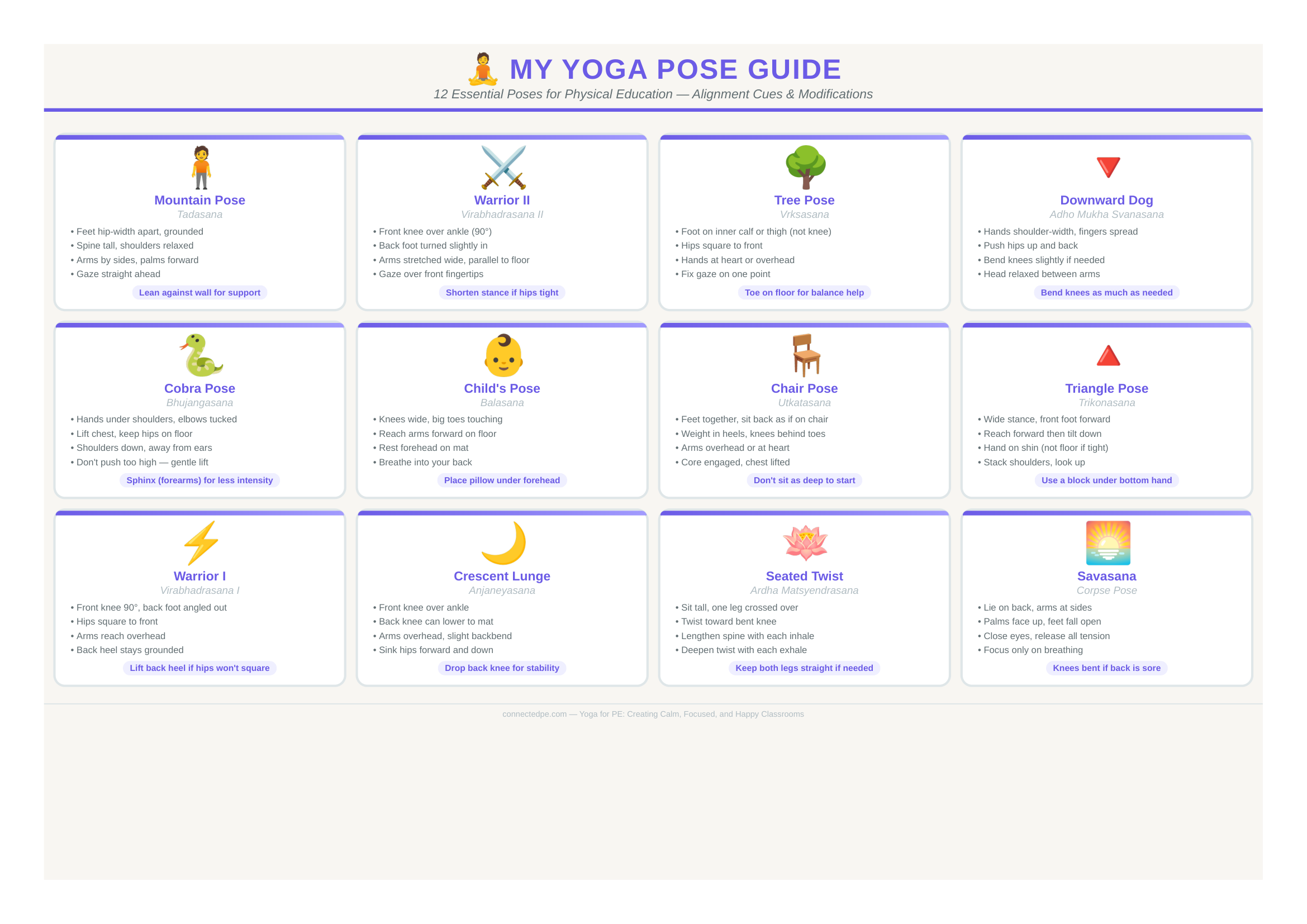
📋 My Yoga Pose Guide
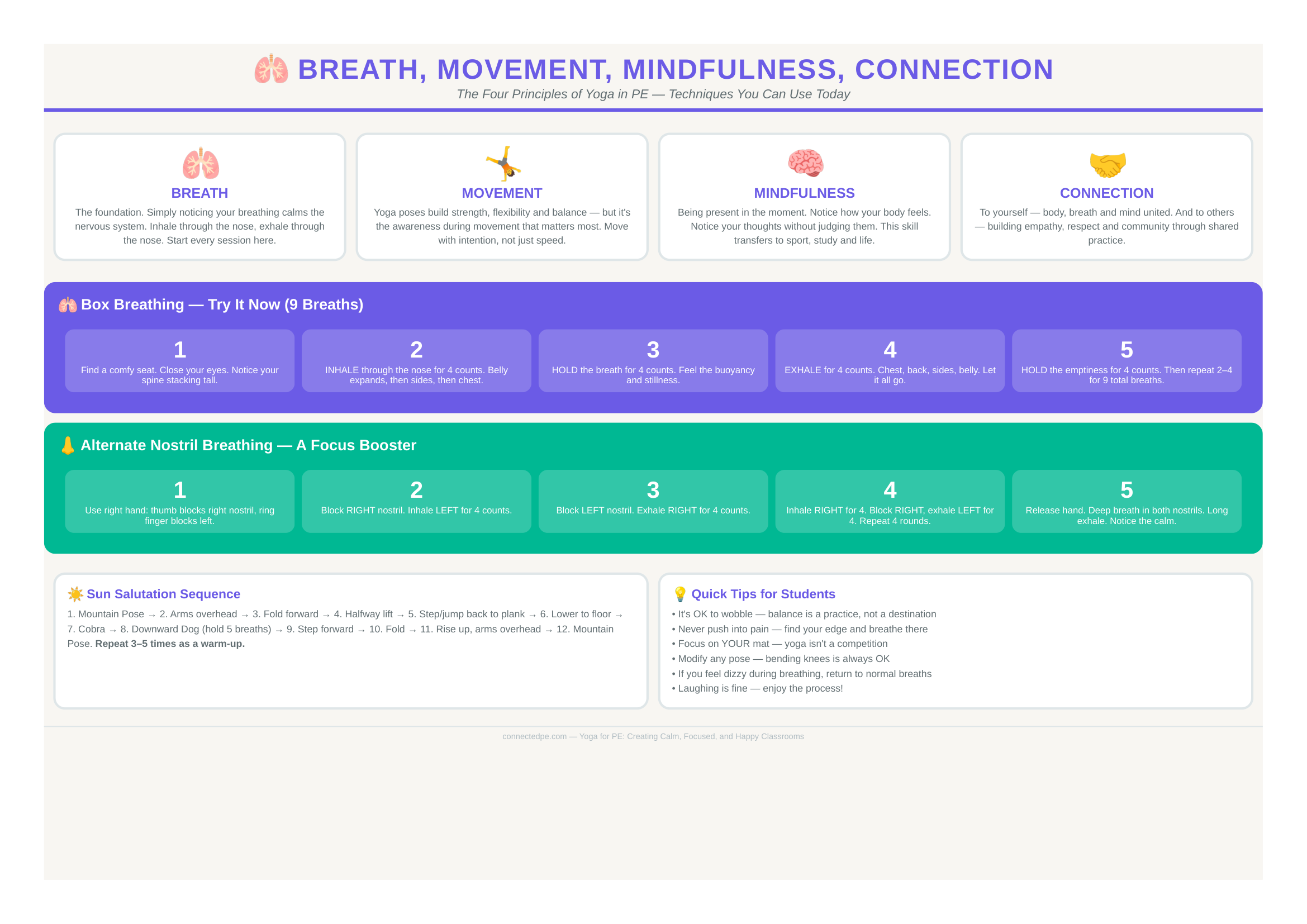
A visual reference card with 12 key poses, alignment cues, and modifications. Page 2 includes the four principles, box breathing, and alternate nostril breathing techniques. Students can use this independently at stations or take it home for practice.
⬇️ Download the Yoga Pose Guide (PDF)
📓 Yoga Reflection Journal
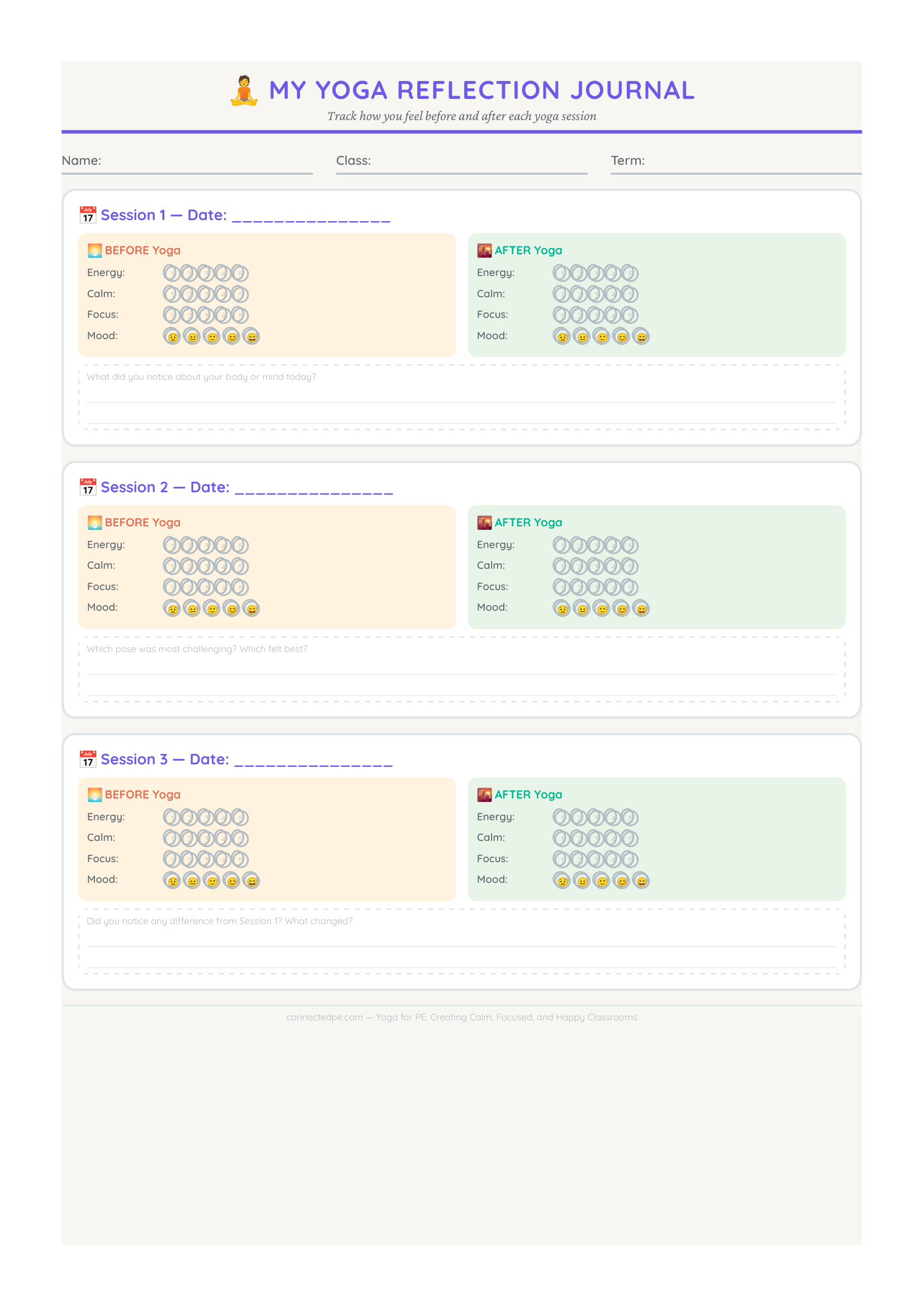
A before-and-after reflection sheet where students rate their energy, calm, focus, and mood before and after each yoga session. Includes 5 session trackers with unique reflection prompts, plus a final reflection page. Perfect for assessment evidence and building body awareness.
⬇️ Download the Yoga Reflection Journal (PDF)
The Bigger Picture
Yoga in PE isn't about turning your gym into a studio. It's about giving students tools they can use for the rest of their lives — tools for managing stress, for understanding their bodies, and for being present.
You don't need to do a full session. Look at the aspects we've discussed and see how you can integrate them into your regular classroom. Where can we interweave breath, movement, mindfulness, and connection into all of our lessons?
The Merrymaker Sisters
Many national and state curricula already have explicit links to the principles yoga addresses — mindfulness, body awareness, stress management, and personal wellbeing. This isn't an add-on. It's core business.
And as one teacher shared after the ConnectedPE session: "I'll be using these techniques in my classroom on Monday morning. My kids will love this."
That's the goal. Start small. Start Monday.
Tags: yoga in PE, yoga for physical education, mindfulness in PE, PE warm up activities, SEL in PE, breathing exercises PE, yoga poses for students